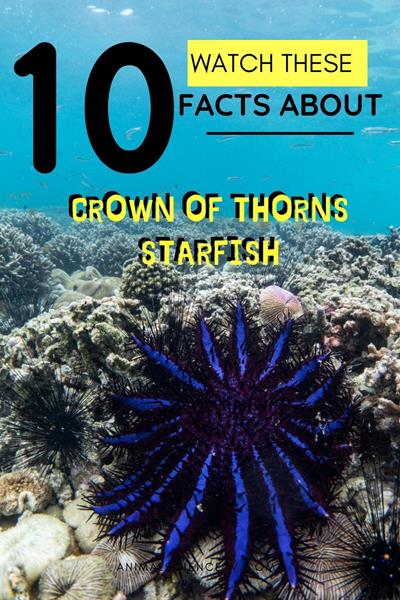
The Crown of Thorns Starfish is an invasive species that feeds mostly on living coral. Did you know starfish have no blood, no brains, and can regrow their lost legs? Below, I will count down from 10 the crown of thorns starfish facts.
How can we use this Crown of Thorns Starfish information to prevent the next outbreak on the great barrier reef? Here’s my video about the crown of thorns starfish facts or if you prefer reading it, scroll below.
RELATED POSTS/VIDEOS: Alaskan King Crabs and 5 Gross Sea Cucumber Facts
10 Fun Crown of Thorns Starfish Facts
Why is this predator so despised by marine biologists and the tourism industry?
10. Coral killers
The COTS (crown of thorns starfish) is a nocturnal predator that feeds on corals. At night, the starfish will crawl out of its hiding spot, and on top of living corals. Starfish have mouths on the bottom. It then ejects its stomach out of its mouth, inside out, onto the reef. Stomach enzymes digest the coral externally.
This animal will then contract its stomach and crawl onto a new fresh patch of coral. As it moves, it leaves behind a trail of white, calcium carbonate, coral skeletons. These starfish can also eat barnacles, sponges, and even algae or plankton if they have to.
The great barrier reef has been reduced to half of its size in the last 30 years. The COTS is the main cause of the destruction, only 2nd to climate change.
9. Strong defenses
The COTS is nearly indestructible. It is covered in thick leathery skin, plated with rock hard “calcium carbonate.” It also has 7-23 arms covered in 2-inch spikes.
These spikes are sharp enough to puncture a wetsuit or fish scales and they are brittle.
This means they often snap off and lodge themselves in the flesh, causing a long term injury with high infection risk. These spikes are also coated in a toxin called “saponin.” Saponin makes the spikes more dangerous but also takes the COTS off of the food menu for most animals.
8. Natural predators
There are, however, some animals that can penetrate the COTS defenses. Pufferfish, harlequin shrimp, and most importantly the giant triton snail are immune to the starfish’s toxins.
The giant triton snail can impale the starfish with its serrated proboscis and inject paralyzing saliva inside. The giant triton then can slowly sand the spikes down and begin to pull them apart.
The COTS can smell the snail’s presence, and the scent causes them to flee or disperse.
7. Population control efforts
Marine biologists hope to introduce more snails to reef ecosystems to naturally control the population. But, the giant triton snail population is currently very low. They have been over-fished for their impressive 2 foot long shells. Even if more snails are introduced, they can only eat 1 starfish per week each.
This means that humans are resorting to unnatural means to reduce the COTS population. Tourism on the Great Barrier Reef alone is a $6.4 billion industry. Dive companies will often let Starfish exterminators tag along with them for free.
Injecting the starfish with bile salts or vinegar has proven effective. It breaks down their cell membranes from the inside out. But, divers can only inject one at a time, and there are millions of these starfish on the reef.
A more effective way to control the population might be to stop the COTS from reproducing in the first place.
6. External Reproduction

Compounding this problem is the insane number of offspring a female can produce. Every year, one female starfish can release over 10 million eggs into the water.
These eggs are fertilized externally and then it drifts around to new reefs in the currents.
COTS cluster together during the mating season into groups called aggregations. Multiple starfish release all of their eggs and sperm at the same time into the water. This act is called “broadcast spawning.”
Releasing 100s of millions of gametes at the same time increases the chances of external fertilization.
Also, having millions of larvae birthed at the same time reduces the chance that all of them would fail. It’s safety in numbers.
Interestingly, when marine biologists put water that smells like the Giant Triton Snail near an aggregation, the breeding starfish will disperse. This could potentially ruin the broadcast spawning event and significantly decrease future population numbers.
5. Outbreaks and farm runoff
Usually, not many starfish survive the larval stage. Algae and phytoplankton are the larvae’s main food source. In normal, clean coastal water, there are not enough nutrients for dense algae and plankton blooms. There is simply not enough food present for millions of starfish larva to survive.
But if there is an extreme weather event, like a cyclone, sometimes farm runoff will mix into the breeding ground. Algae and plankton will feed on dissolved farming fertilizers, and bloom. Now we have a big problem. Way more starfish survive early life and there is an outbreak.
On the Great Barrier Reef, during an outbreak, which lasts over 15 years and several generations, a massive swarm of COTS sweeps southward devouring the corals in its path.
4. Starfish regeneration
Starfish can lose legs from predatory attacks. Sometimes they even release a leg on purpose to allow a predator to eat it while escaping. Lost limbs take about 6 months to regrow.
Amazingly, if a removed limb is not injured too badly, it can regrow into an entirely new starfish! This regeneration makes it hard for divers to kill the COTS. Sometimes they have to inject every leg individually with poison to make sure the entire thing dies. A more certain killing solution is to just remove them from the water.
3. No blood or brain
Starfish don’t have blood. Instead, they pump seawater through their bodies to bring nutrients to their cells. They will never bleed to death in the water, but this makes them super vulnerable when on land.
Starfish don’t have lungs, instead, each of their cells individually relies on simple diffusion for gas exchange. Most starfish can only “hold their breath” for about 30 seconds out of the water before they die of carbon dioxide poisoning.
Starfish also don’t have a brain. However, they do have a nervous system and will react to pain and environmental stimulus. They even have eyespots at the end of each leg, helping them stay hidden in the darkness.
Having no brain suggests that starfish are in no way conscious and therefore can not suffer.
The fact they are not conscious and are a major threat to reef ecosystems leads most humans to not think twice about killing them.
We have a new Patreon this week! Thanks Emily for supporting the Animal Science TV Project! You can check the description if you want to help this channel grow, too.
Check my Patreon
2. The 2nd largest “Sea Star”
Scientists are trying to rename the “starfish” the “sea star.” because starfish are not fish. They are not even close to fish.
The COT Sea Star is the 2nd largest sea star in the world, growing up to a 2.5-foot diameter. The only larger sea star is the sunflower star it can grow up to 3-feet long.
Sea stars move their legs and hundreds of little feet by changing the water pressure throughout their bodies. Their tube-like feet can actually allow them to move quite quickly, about 65-feet per hour.
1. Ecological benefits
Coral was one of the first animals to evolve, and it survived alongside the COTS for hundreds of millions of years.
The COTS is becoming an invasive species because human activity is artificially changing the water chemistry of reef ecosystems. The predator-prey balance is shifting in favor of the starfish, against giant triton snails, and against corals.
A potential benefit of COTS is that it eats mostly fast-growing, hard corals. In small numbers, the COTS will make room for rarer, slow-growing, soft corals in reef ecosystems.
For today, the culling of the COTS will continue until the coral they feed on is no longer at risk of extinction. `
Next on Animal Science TV, we feature the Cassowary Facts. This living dinosaur is considered to be the world’s most dangerous bird.
Checkout this playlist for my complete cool animal facts playlist. I also do 101 science education videos and live animal news with the audience.
SAVE THIS ARTICLE ON YOUR PINTEREST BY PINNING THE IMAGE BELOW