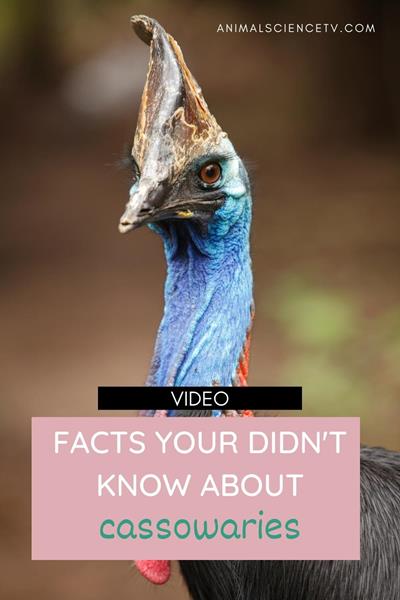
This week, I talked about Cassowary. I’ve seen one in Australia and have been fascinated with them since. Cassowaries are known as the world’s most dangerous birds. The males are great dads! Why did the Cassowary lose its ability to fly?
If you don’t feel like reading today, you can also watch my 10 cool cassowary facts below:
10 Cool Cassowary Facts
When I was hiking in the Australian bush one night, someone shouted, “Look out for the Cassowary!”
I asked, “Why?”
My name is Chris, and here is what I learned about the world’s most dangerous bird.
ALSO, CHECK OUT: Saltwater Crocodile Facts and Gross Tapeworm Facts
10. The murder bird
The cassowary is taller than your average human and weighs up to 165 pounds. It is a flightless bird that can run 30mph, jump 7 feet vertically, and packs a powerful kick.
The feet are equipped with 3 talons. The inner talon can be 4inches long, and it is So sharp that tribesmen in Papua new guinea use it to sharpen their spears. The Cassowary is capable of inflicting lethal wounds to humans when defending itself, its young, or fighting for food.
In a 1926 attack, an Australian rancher had his throat punctured by a single kick. And In 2019, an exotic pet keeper in Flordia suffered 12 lacerations, one severing his brachial artery. He bled to death in about 30 minutes.
9. Territorial but shy
Cassowaries will violently defend themselves, but they are not aggressive in nature. They prefer to be left alone and live solitary lives. The cassowaries dark feathers allow it to hideaway deep in the jungle, camouflaged by shadow.
In Australia, you are actually over 100x more likely to be killed by a dog than by a Cassowary. Maybe this is because there are only 4,000 cassowaries remaining in the wild.
I could only find 2 human deaths caused by the cassowary over the last 100 years. The fear of these animals is unwarranted.
8. Male caretakers
Cassowaries only come out of solitude during mating season. Each year, a female can mate with up to 4 different males. For each male, she leaves a batch of 3 to 8 huge green eggs. They are the 3rd largest bird eggs in the world, at 1.5 pounds.
The females leave the eggs in a makeshift ground nest called a “scrape,” and then they are incubated by the male! After about 50 days the baby cassowaries hatch, and Dad is in charge of their care. Over the next 10 months, the cassowary chicks follow him like ducklings. He protects them and teaches them how to find food.
Once the babies lose their brown baby fur and can defend themselves, dad will shoo them away and look for a new female.
7. Frugivores and poop
Cassowaries are frugivores, meaning they eat mostly fruits. Cassowaries get most of their calories by eating 11pounds of fallen fresh fruit per day. A 165lb carnivorous bird would be just as scary as a dinosaur, but luckily cassowaries get their protein from mushrooms, bugs, and old dead meat called “carrion.”
This is probably one of my least favorite cassowary facts. Cassowaries can’t chew, and don’t have the digestive system to absorb all of the nutrition from unripe fruit in one pass. Therefore, they frequently will eat their own poop and other cassowaries’ poop for a second digestive pass. Smart energy savings!
6. Living dinosaurs and evolution
The Cassowary looks much like its ancestors did, today. All birds have evolved from flightless, hallow-boned, feathered dinosaurs, called the “Therapods.” The velociraptor and t-rex are examples of some therapods.
About 150 million years ago, in the Jurassic period, birds gained flight and diverged on their own evolutionary path.
When the dinosaurs went extinct 65 million years ago, some birds survived. After just 5 million years of evolution, a new group of flightless birds emerged.
These were called the “Ratites.” The ratites no longer had to deal with the threat of the carnivorous dinosaurs.
They lost their wings and filled the niche that the dinosaurs left behind. Over time, the Ratites needed to get better at defending against terrestrial predators. They became larger, faster, and stronger.
We know them as emus, ostriches, kiwis, and Cassowaries today!
5. Vestigial wings

Vestigial structures have lost “most or all of their ancestral function.”
In humans, some vestigial traits are getting goosebumps, which is supposed to puff up our hair in a defensive posture, and the appendix. The appendix used to be bigger and was used for digesting stuff like tree bark.
After millions of years of being flightless, the Cassowarry’s wing has become much smaller. Its 6 primary wing feathers have become spines, and the wing is tipped by a single talon. These adaptions have made the wing useful for defense on the ground.
Cassowaries have also lost their tail feathers over time, and most of their feathers look more like hair today than feathers.
Leave me a comment if you can think of any other animals with vestigial traits.
4. The casque
The cassowary has a prominent keratin helmet on its head, called a “casque.” Kerotin is the same protein human fingernails and hair are made of. Scientists don’t know exactly what the casque’s purpose is. It could be used as armor in fights, or to protect the skull when running into a tree at 30mph.
Having a nice casque could also be sexually attractive.
I think the Casque is probably used mostly like an antenna, for acoustic reverberation. The cassowary produces the lowest-pitched sound of all birds, barely audible to humans as a rumble. The casque could help other cassowaries hear each other.
We made it to $24 per month Patreon donations! I really appreciate you guys helping me persue my passion.
3. Warning signals
This deep sound is used to communicate territory and as a warning signal. If you see a cassowary rumbling, fluffing its feathers, and stretching its neck.
A 2001 study found that in 150 Cassowary attacks, 22% were caused by them defending themselves, their chicks, or their eggs.
Amazingly, 73% of attacks were caused by the Cassowary having a poor interaction while being fed by humans.
It seems that if a Cassowary is expecting food, and not given it, or if its food is taken away, it may charge the person.
Cats and dogs will just beg and whine for food, but a Cassawary sometimes will full-on assault you!
2. Species and range
There are 3 surviving species of cassowaries. They can be identified by their “wattles.” Wattles are the skin flaps on their necks, like a rooster.
The southern Cassowary was featured in this video and is mostly found in Northeastern Australia. It has 2 wattles.
The northern cassowary and dwarf cassowary are found in Papua New Guinea and surrounding islands.
The northern cassowary has 1 wattle. The dwarf cassowary is the smallest, and has no wattle!
1. A species at war
Cassowaries are listed as endangered in Australia. They are under threat by animals eating their eggs, hunting, habitat loss, and road building. Unlike flying birds, the cassowary is not good at avoiding collisions with vehicles.
The cassowary also is a natural prey for the dingo. This means cassowaries are naturally fearful of dogs. Dogs and cassowaries may attack each other on-site, resulting in a brutal fight.
Also, feral pigs eat the same food as the Cassowary… along with their eggs and chicks.
Cassowaries are important for the ecosystem because their gentle digestive systems do not destroy seeds. They help spread seeds, and please remember, they are not that dangerous.
The cassowary is a species in vital need of protection, but the Koala is hogging a lot of the conservation funding due to its popularity and cuteness.
FINAL THOUGHTS
I hope that you enjoyed this list of 10 cool cassowary facts. Next on Animal Science TV, we feature the dog.
Learn more cool animal facts by checking out my playlist. I also have a science education series and do a live animal news show with the audience.
SAVE THIS ARTICLE ON YOUR PINTEREST BY PINNING THE IMAGE BELOW