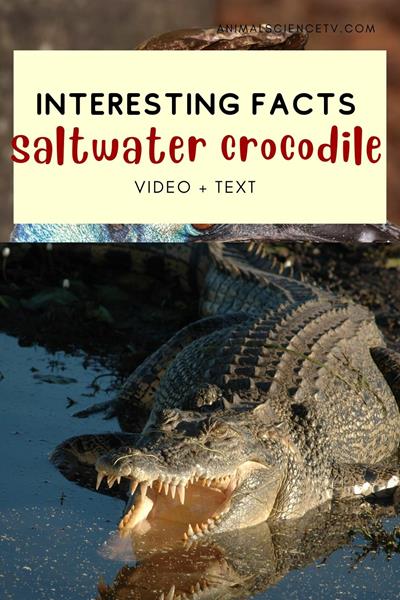
Saltwater crocodiles are the largest reptiles living on Earth today. Salt-excreting glands on their tiny tongues allow them to survive in the open ocean and emigrate to new countries. Did you know “salties” can not swallow underwater?
Watch my video of 10 cool saltwater crocodile facts, or read the article by scrolling past the video.
10 Cool Saltwater Crocodile Facts
Australians sometimes call these animals “Salties!”
But don’t let the cute name fool you; one of these monsters could really ruin your day in a snap. Today we learn what makes Saltwater crocodiles such feared predators.
If you like animals that live on the water or around it, my video and article about facts about water striders are now live.
10. Floaters
Saltwater crocodiles follow ocean currents to cover distances of over 500 miles.
When they emigrate like this, they are called “floaters” because they float most of the way to save energy.
Floating is risky because the animal is at the whim of the currents for weeks, but these exiles are usually the individuals who lost territory disputes, could not court a mate, or find food.
Saltwater crocodiles have special salt glands on their tongues, which allow them to survive in the open ocean. If their blood gets too salty, they can excrete thick, tear-like mucus.
Salties rarely hunt in the open ocean but have been spotted on coral reefs. Usually, when you see a saltwater crocodile swimming parallel to the coast, it is searching for a mate or better territory. It is looking for a new river to swim up.
Crocodiles are territorial, aggressive, and unpredictable, especially when defending their eggs.
They might kill you not out of hunger but because you disturbed them.
9. Temperature-controlled babies
Females lay up to 90 eggs, which the mother incubates. Amazingly, the sex of the babies is determined by temperature… Colder temperatures result in primary females, while warm eggs hatch into males. A medium temperature incubation results in closer to an even 1:1 mixed ratio of the sexes.
Crocodiles are good mothers. Mom transports newborn hatchlings to the water’s edge, carefully in her mouth. There she protects her babies as they learn to swim and defend themselves.
Sadly mom does not help them hunt, and usually, only one or two of the 90 hatchlings actually make it to adulthood.
What do you think would happen to human families if we could choose a baby’s sex simply by turning a knob on the heater? Leave me your answer on the comment section below.
8. A wide territory
Saltwater Crocs live in India, Sri Lanka, South-East Asia, Australia, and several Pacific islands.
They spend most of their time hunting in murky estuaries and mangroves with a brackish salinity. Although their name wouldn’t suggest it, these monsters can also live quite far inland in freshwater too.
It scares me how vast their territory is; they could be anywhere!
7. Agile giants
Saltwater crocodiles are the largest reptiles living on Earth today. The world record is held by a male captured in the Philippines named “Lolong.”
He was measured at 20ft 3 inches long and weighed 2370 pounds. (6.17m and 1075kg)
Although huge, these reptiles are very agile in the water.
They can fold their limbs against their body into a streamlined shape and use their tail as powerful fins to swim up to 18mph. Michael Phelps? He can only swim 6 Mph!
7b. Croc vs Alligator
Identifying a crocodile versus an alligator is simple.
Crocodiles are significantly more dangerous than alligators, so knowing what you are dealing with is good.
Crocodiles have V-shaped snouts, while alligators have U-shaped snouts. You can see a crocodile’s interlocking lower teeth when its mouth is closed, but you can only see its top teeth when an alligator’s mouth is closed.

6. A crushing bite
The saltwater crocodile has the 2nd strongest bite force ever recorded, at 3,700 Pounds per square inch. This hydraulic car crusher is wimpier, at only 2000 PSI.
For comparison, the saltwater crocodile’s bite is 26 times more powerful than the average human’s bite.
The only animal with a stronger MEASURED bite is the Nile crocodile, at 5000 PSI.
You may have noticed you can not see any crocodile’s tongue. It is tiny and mainly used to seal the throat shut when underwater. Luckily, it can not be accidentally bitten.
5. Death rolls
Salties have 68 teeth, which can be replaced 50 times in their lifespan! Crocs do not chew… instead; they use their blunt teeth to clamp down on their prey.
They then drag the prey to the bottom of the water and begin violently rolling… Like a log roll.
The goal is to drown the prey and, at the same time, rip off its limbs to eat in bite-sized chunks.
Thankfully saltwater crocodiles are only estimated to attack 30 people annually, but astonishingly, about half of these attacks are fatal.
Combined, all species of crocodiles kill about 1,000 people per year compared to 1000 sharks, who kill less than 10 people per year.
4. Digesting bones
Because Saltwater crocodiles eat their prey whole, they need very powerful stomach acid to dissolve hooves, bones, and shells.
Besides humans, they like to eat fish, birds, sharks, turtles, crustaceans, and even large mammals like pigs and water buffaloes.
Crocodiles can NOT eat underwater. They prefer to drag their dismembered prey onto dry land or shallow water to swallow it finally this avoids taking in too much water.
3- Sneaky ambush predators
Crocodiles are very stealthy. Their eyes, nostrils, and ears are all on top of their head so they can sense their surroundings above water while only having a small part of their camouflaged head above the surface.
This allows the crocodile to silently sneak up on an animal drinking from the water’s edge and surprisingly lunge forward.
Another tactic salties use is to hold their breath underwater and wait for prey like turtles or fish to move within striking range.
They can lower their heart rate to 3 Beats per minute, saving energy and allowing them to hold their breath for an hour if stationary.
While hiding on the bottom, a saltwater crocodile’s skin can sense tiny changes in the water pressure around them.
With thousands of these sensors, they know when prey is nearby, even in the murky darkness below. These organs are called “dermal pressure receptors.”
3b. Crocodile communication
Crocodiles communicate with chirps, growls, hisses, and by blowing bubbles.
They can communicate over 20 messages, including distress calls, threats, and courtship bellows!
2. Surviving the Meteor
Cold-blooded crocodilians were around when the dinosaurs went extinct some 65 million years ago.
Scientists think they could withstand the blacking out of the sun and global cooling events because of their low metabolism. Crocodiles can even enter a hibernation-like state called “brumation” and survive up to 3 years without food.
Dinosaurs are thought to have been warm-blooded like their ancestors, the birds, so they could not survive long without abundant calories to maintain their hot body temperatures.
1. Salties scare people
Humans are more dangerous to saltwater crocodiles than giant asteroid impacts are. They are hunted for their leathery skin, and meat, and for the sake of public swimming safety.
Saltwater crocodiles are scary, and around the world, they are frequently killed out of fear alone.
In Australia, this species’ population was pushed down to just 3,000 individuals in the 1970s. Today, they are protected in Australia, and the species has recovered to over 150,000.
FINAL THOUGHTS ON SALTWATER CROCODILE FACTS
When I visited Australia, I was also nervous about swimming in certain areas, so I understand why people are tempted to kill them for safety reasons. Still, Saltwater crocodiles are apex predators, and they are needed to balance some brackish ecosystems. Improving the health of ecosystems benefits humans by improving food security as we move into the future.
Head to my Youtube playlist where you can choose between animal facts, animal education , and animal news.
SAVE THIS ARTICLE ON YOUR PINTEREST BY PINNING THE IMAGE BELOW