Red King crabs are native to the northern pacific, but they are an invasive species in Norway. I think the coolest facts abodut Alaskan King Crabs are their migration, limb regeneration, and life cycle.
In this article, I will discuss about King Crab in great detail. You can also watch my video which contains 10 cool facts about Alaskan King Crabs and basically, everything you need to know. There are 3 main species of King Crabs in Alaska, but we focus mainly on the Red King Crab.
10 Cool Facts about Alaskan King Crabs
Ocean acidification caused by climate change is a bigger threat to King Crabs than overfishing. Do you know how their life cycles work, and how Russia introduced them to the Atlantic? They are now an invasive species.
ALSO READ (OR WATCH): 5 Gross facts about Hagfish or 10 facts about Crow of Thorns Starfish
10. King Crabs are not true crabs
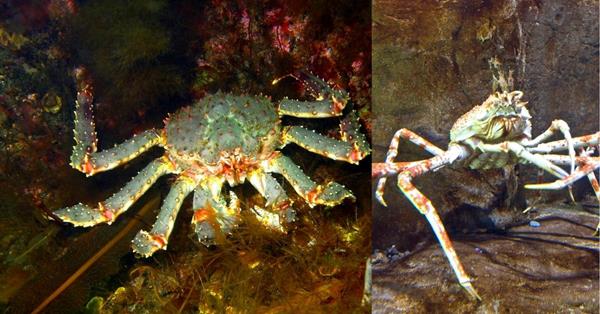
King crabs belong to a super-family called “Lithodidae.” They are actually quite different from true crabs. True crabs walk sideways, can survive on land, and have quite a different anatomy.
King crabs can only survive underwater, and they walk forward due to the different angles of their leg joints. Look at these images of kind crabs versus true crabs. They appear to have 2 fewer legs than true crabs do.
Interestingly, The king crab, along with all crustaceans, literally has blue blood. King crabs transfer oxygen with a blue copper-based molecule called “haemocyanin” using their 5 gills. Mammals use a red iron-based molecule called “hemoglobin,” in their lungs.
9. All crabs are decapods
The word “Decapod” combines the words “deca,” greek for 10, and “arthropod.” Arthropods have symmetrical legs and exoskeletons. They have further evolved into animals such as insects with 6 legs, arachnids with 8 legs, and decapods with 10 legs.
In the case of king crabs, who have 10 legs, the front pair of legs have evolved into pincers. These front pincer legs are used for both offence and defense.
Females have 2 pincers of the same size, while males have 1 asymmetrical larger pincer used to wave at females. If he has a very large pincer and is able to wave it quickly, it means he is a good, healthy, and attractive mate.
The back pair of legs are so small that you can’t see them, and they have evolved for sexual applications. The male will use his tiny rear legs to transfer sperm to the female. The female will use her hidden rear legs to defend and care for the fertilized eggs she carries in her underbelly pouch; somewhat like a kangaroo.
We will talk more about reproduction and the life cycle later.
8. King crabs create a defensive aggregation pods
During the non-breeding season, king crabs are solitary creatures. But, during the breeding season, they have been observed engaging in an incredible cooperative defensive strategy.
It reminds me of the formation used by the Spartans in the movie 300. They stack up on top of each other, with pincers facing in all directions. The males defend the females, sometimes in numbers of over 1000 individuals stacked over 10 feet tall. This cooperative social defense makes them an overwhelming threat to most attacking predators.
This behavior is called plodding. But, the king crab’s main defense is its spiky hardened exoskeleton shell, called a carapace.
7. King Crabs go through molting and regeneration
One of my favorite cool facts about Alaskan King Crabs is their regeneration. The king crab’s carapace could be likened to the armor of a medieval knight. It cannot expand at all, and this is a problem. The crab itself keeps growing, while its armor does not.
The crab needs to escape its armor. To do this, the crab excretes an enzyme that loosens its connection to the armor, and cracks the underside of the carapace wide open.
The crab is now able to escape from the armored carapace through this crack and is now very vulnerable. We call this process of shedding the hardened exoskeleton molting.
After molting, the king crab is only wearing a flexible soft shell. It needs to hide and wait for about a week to grow a new larger armored shell.
The king crab will then be safe until it outgrows its armor again. During a king crab’s 20-30 year life span, it will molt this exoskeleton about 20 times.
If a king crab loses a leg or pincer from combat with another crab, or from a predatory attack, it can gradually regenerate the limb with each molt. Limbs can only regenerate while in the flexible soft-shell form.
6. King Crab is invading Russia and Norway
Red king crabs are originally native to Japan, eastern Russia, and Alaska. They are not an ecological problem in the northern pacific because they are preyed upon by the giant pacific octopus in these waters.
But, in the 1960s, Russia intentionally introduced the Red King Crab to the Barents Sea. The Barents Sea is in the Arctic Ocean and is between Russia’s western shoreline and Norway.
The plan was to introduce the king crab to the Arctic ocean, creating a crabbing industry to help the Russian economy. But this turned out to be an ill-advised move. The crabs quickly spread around, and by 1990, they invaded Norway’s Atlantic waters.
As you might have guessed, the pacific giant octopus is not present in the Atlantic Ocean, so the red king crab is now an invasive species in Norway. Without this octopus present, the red king crab is now an apex predator in this part of the world.
An apex predator is an animal that is at the very top of the food chain. Today, in Norway, the king crab is now destroying the native marine ecosystem. The king crab kills almost everything in its path, and there are almost no predators to prey upon it.
However, the king crab is not invasive in Alaska, because the giant pacific octopus is naturally controlling the crab population as part of the healthy local ecosystem.
5. Incredible life cycle
Breeding occurs in the warm waters of the inter-tidal zone during the late spring. The inter-tidal zone is the area near the shore between low and high tide; where you would find tide pools.
King crabs can only breed immediately after molting, in their flexible soft-shell form. This act takes more than a day. The male hangs onto the female transferring sperm with his tiny rear legs. The breeding pair is very vulnerable during this time.
Once fertilized, the female carries an astounding 50,000 or more eggs in her abdominal pouch for over an entire year until they hatch into larvae. She uses her 5th set of hidden legs to clean and care for her future offspring during this year.
Disturbing just one breeding pair could potentially reduce the population of red king crabs by tens of thousands. For perspective, the estimated population of these crabs in Alaska is only about 20 million.
When the fertilized eggs eventually do hatch in the inter-tidal zone, larvae emerge as a tiny shrimp-like creature, that can swim. Shrimp are also decapods.
These tiny king crab larvae feed only algae and plankton for about 3 months, and after 5 molt cycles, they transform into baby king crabs that sink to the seafloor.
They are now about the size of a penny and hide in the nooks and crannies of the inter-tidal zone. When they grow large enough to defend themselves, they become carnivorous.
4. Interesting migration and gross diet
These tiny young crabs first migrate to reefs in shallow waters; where they hide and attack other animals while growing into adults. On the reef, As they grow larger, they begin to eat sea urchins, molluscs, small fish, worms, snails, sea stars, sand dollars, and barnacles. King crabs take about 5 years to reach sexual maturity.
After the reef is picked clean, the crabs move down into the deep sea, eating whatever they can find along the way. They mostly collect falling detritus at this depth.
Detritus is animal waste falling from above, or small pieces of fish that were killed by another predator from far above. While in the deep sea, the king crab is mostly a scavenging bottom feeder.
It can easily kill other species of unfortunate bottom feeders if they happen to cross paths. If the king crabs are lucky, a dead whale will sink to the bottom and they can feast on the carcass for weeks.
Annually, the adults flee the intertidal zone because the surface freezes, so they migrate about 100 miles away into the deep sea to scavenge for more food. King crabs are too heavy to swim and only walk at 0.15mph.
Red king crabs thrive at depths of 600 feet in near-freezing, 3F- 50F saltwater. (freshwater freezes at 32F, but saltwater doesn’t freeze until temperatures drop below 28F).
3. Threats and conservation efforts
The red king crab is an important part of the ecosystem in Alaska, and it is an essential food source for the giant pacific octopus. The king crab is threatened by over-fishing, and would probably be extinct today if not for fishing regulations. King crabs are a popular food item because they are high in protein, low in fat, and have a high concentration of many essential vitamins.
This crab is also considered a delicacy, and a single crab sells for $100 to 300, based on its weight. The Red King Crab is one of the largest crabs in the world. It can grow up to 30 pounds with a 6-foot leg span.
3.2 Exotic meal
Sadly, some people enjoy eating exotic animals. This $100+ price per animal, combined with the relative ease of catching them, makes them a prime target for fishermen. To catch king crabs, crabber push something called a “pod” off the side of the boat.
The pod is a metal cage loaded with “bait,” which is usually some type of dead fish or chum. The pod quickly sinks to the seafloor and is attached to a buoy by a rope that could be 650 feet long.
The fishermen leave these traps in place for several days, hoping that migrating crabs will crawl into them. During the short winter crabbing season, the crabs are no longer in the warm, shallow, breeding grounds.
The crabbing season in Alaska only lasts for about 2-4 weeks, and only during the wintertime.
As I explained earlier, there are about 20 million king crabs off the shores of Alaska, but we need to avoid fishing them during spawning while the females and young small crabs are vulnerable. This 2-4 week per year limited fishing season is essential to maintaining a healthy population.
Even during the short fishing season, females and young crabs are required to be thrown back. Crabbers can easily tell males from females by the shape of markings on their undersides.
The Animal Science TV project is only made possible by my Patreons who support me as a growing small channel. I just started doing this full time, and want to give special thanks to my new Patreon “Julie Acepilot” who has given me some awesome video suggestions. Julie’s support helps motivate me. Check my Patreon page.
2. King crabs’ natural predators
The king crab is a semi-apex predator itself, but it is easy prey for the giant pacific octopus. In the deep sea, Other animals that might try to eat a king crab include sharks and some large deep-sea fish.
While in the reef and intertidal zones, sea otters and birds of prey may attack. But the king crab is nearly invulnerable with its spiked carapace and powerful pincers.
Natural Predators generally will only target small baby king crabs or even adults who have just molted and are in their flexible softshell form. But the main threat to these amazing creatures, like almost all animals, is humans.
1. Ocean acidification concern
Over-fishing is a problem, but with strict regulations, we have been able to maintain the red king crabs population. The real future problem is ocean acidification. Climate change is likely to cause the extinction of most marine crabs within 100-200 years.
Not only crabs but all crustaceans and corals. The animals that rely on crustaceans as a food source will become threatened as well.
- Ocean acidification is quickly explained, by the fact that as CO2 is released into the atmosphere by burning hydrocarbons, it also dissolves into the ocean. Dissolved CO2 creates carbonic acid.
- The ocean is getting more and more acidic every year, and this acidity will inevitably dissolve all calcium-based shells and exoskeleton. This acidification is happening much faster than evolution can allow these animals to adapt to.
This mass extinction event will go all the way up the food chain, eventually affecting humans themselves. Losing the ocean as a viable food source will be a disaster. We need to act today to reduce carbon dioxide emissions if not for ourselves during our own lifetimes, but for the future of all animals.
Ocean acidification is likely to cause a global food shortage and the extinction of king crabs.
I hope that you enjoyed these 10 cool facts about Alaskan King Crabs. Please watch more cool animal facts in this playlist, I also do 101 science education videos.
We do a live animal news show with a special guest host on Sundays, where subscribers can chat with me or ask questions. Thanks for watching Animal Science TV.
SAVE THIS ARTICLE ON YOUR PINTEREST BY PINNING THE IMAGE BELOW
