The Monarch Butterfly is very cool! Here are some Monarch butterfly facts in the video explanation. I think the coolest fact about Monarch butterflies is their incredible migration. Did you know all of these Monarch butterfly facts?
Here, the Monarchy Butterfly Migration is explained in great detail. It contains everything you need to know.
10 Cool Facts about the Monarch Butterfly
The Monarch Butterfly’s most impressive fact is its incredible Migration, but to understand that, we need to begin with the egg.
10. Eggs are only laid on Milkweed
The monarch butterfly’s life cycle begins by being laid as an egg on a milkweed leaf. A female usually lays about 200 eggs, 1 at a time, on different leaves and plants in different locations. She uses special chemical receptors in her feet and antenna to “taste” the quality of the milkweed plant.
Milkweed contains toxic chemicals called “cardiac glycosides,” which monarchs are immune to, which is essential for the Monarch’s defense.
9. Caterpillars are eating machines
After about 1 week, the eggs will hatch, and the larval version of the butterfly, called a caterpillar, emerges. It immediately eats its own eggshell, then starts devouring the milkweed leaf plant it was placed on.
The caterpillar will eat 20 times its body weight per day of milkweed leaves. The caterpillar concentrates toxins in its body as it gorges on milkweed. This is later used as a deterrent and makes the butterfly toxic to most predators.
The Monarch caterpillar takes about 2 weeks to complete this stage of its life cycle. During this larval stage, the caterpillar sheds its exoskeleton about 5 times before reaching maturity. Each of these stages is called an “instar.”
A random cool fact about caterpillars is that they actually only have 6 true legs, like all insects. The 10 small things that look like legs on the back half are called “pro legs”, and they will be lost during metamorphosis.
8. The pupa stage and metamorphosis
Only 5% of the caterpillars make it to this final pupa stage because they are easy prey to invertebrates like spiders, ants, and wasps.
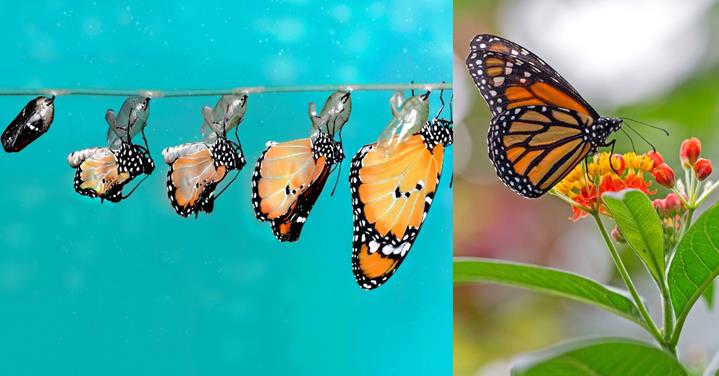
When caterpillars finish the growth stage, they shed their exoskeleton, hang themself upside down, and wrap themselves in silk. The chrysalis is the butterfly’s version of the moth’s cocoon that you might already be familiar with.
Inside this chrysalis, the pupa goes through a process called metamorphosis. In 10 days, it grows wings and transforms into a butterfly. Just a few hours after breaking out of its chrysalis, the monarch butterfly can unfold its wings, dry off, and fly away.
7. Finally, we have the Monarch Butterfly
The mouth of the Butterfly is completely different from the larval caterpillar. The caterpillar can eat milkweed with its mandibles, but as a butterfly, it now has a proboscis. This straw-like structure cannot chew, so the butterfly can only ingest liquids like the sugar-rich nectar of flowers.
Monarch butterflies are sexually mature after only 3 days, so the cycle of being born as an egg to laying an egg as a mature female takes less than one month.
Monarchs are native to North America, but they have been introduced to other areas of the world like South America, western Europe, India, Australia, and some pacific islands like Fiji. For our purposes, we will just discuss the North American monarch butterflies.
The vast majority of these butterflies are born in either their summer breeding ground of eastern Canada, or the winter breeding ground of central Mexico’s mountainous Oyamel fir forests.
6. Beautiful Aposematic Colors
One of the reasons people love Monarch Butterflies is because of their majestic orange and black color. This color is “Aposematic,” meaning it serves as a warning sign to predators that this animal is not good to eat because it is poisonous.
Remember how the caterpillars spent so much time eating toxic milkweed leaves? That is because they carry that poison into their butterfly form. As we just learned, monarch butterflies can no longer chew leaves with their proboscis, so all of their toxicity was built in their previous life stage as a caterpillar.
The Monarch has a very distinctive look, and most predators, such as birds, who are unfortunate enough to eat a Monarch, will become sick and vomit. The bird will quickly learn not to eat Monarch Butterflies ever again. This is their primary defense mechanism.
5. An incredible migration
Unlike most butterflies, Monarchs cannot survive cold temperatures, so they must Migrate. Every year they travel over 3000 miles from Canada to Central Mexico. This happens in the fall as temperatures start to cool.
Normally, the Monarch’s life span in butterfly form is only about 1 month long. This helps them breed quickly, which increases their numbers, and also allows evolution to occur at a fast pace. Several generations are born and die in their warm-weather breeding grounds.
But, flying to Mexico takes about 2 or 3 months, so the Monarchs cannot make the 3000-mile migration during their short lifespans.
4. Super Generation Monarchs
Something very unique happens when the weather starts to cool. During the last generation, before the migration begins, females can lay eggs with a reduced level of “juvenile hormone.” These eggs, caterpillars, and chrysalises take longer to develop. It results in a super generation of Monarchs. Ones that grow larger and can fly further. But this comes at a trade-off.
They are sterile and cannot reproduce. Instead of using their energy to make sperm and grow eggs, they save it to prepare for an incredible journey. These “super generation monarchs” live 8 times longer than the normal monarchs. Super generation Monarchs can fly at 12mph, up to 30 miles per day, and at altitudes over 10,000 feet. They can make it all the way from Canada to Mexico.
But how would they navigate if no living Monarch has ever taken the journey before to show them the way?
3. A Biological Clock and Compass
The way Monarchs navigate is by following the sun using their genetics. They are able to fly directly south, but following the sun alone would not work because the sun moves across the sky over the period of a day. Monarch butterflies can calculate the south direction by knowing what time of day it is.
For example, at 8 am, the sun would be very far to the east, at 10 am slightly east, at noon directly south, at 2 pm slightly west, and at 4 pm very far west. The monarchs adjust their flight path to head due south no matter where the sun is because they know exactly what time of day it is.
Monarch butterflies have this internal clock built into their brains and antennas. They used these biological tools to make a very accurate solar compass, just like colonial sailors did.
I think it is very incredible that a species that cannot live long enough to survive the 2-way migration is able to find itself exactly back in the same mountains of Mexico every winter.
2. A return to short life cycles
Amazingly, this “juvenile hormone” that was suppressed in Super Generation Monarchs turns back on when they have finished the Migration to Mexico. With the juvenile hormone now being produced, the once sterile monarchs can finally mate before they die.
This next generation of offspring will have the juvenile hormone turned on, so the population grows quickly again with short life spans. The Super Generation Monarchs will not be born again until it is time to migrate north to Canada.
1. Why are Monarchs important?
Monarchs are currently listed as a threatened species. They were able to move off of the endangered list thanks to conservation efforts. Monarchs are generally viewed as beautiful. They are one of the easier species to convince humans to help preserve.
Also, they are useful pollinators but not nearly as effective as fuzzy insects like bees. Monarchs are colored a beautiful orange as a warning sign that they are poisonous, but ironically, they are most important to the ecosystem as a food source for bats. Bats are immune to the Monarch’s toxins.
We can all help preserve the Monarch population by protecting their breeding grounds. If you want to see some in your yard, try planting some milkweed.
Head to my Youtube playlist where you can choose between animal facts, animal education , and animal news.
SAVE THE PHOTO BELOW ON YOUR PINTEREST TO BOOKMARK: