These monsters have truly unique visions. They can calculate distance using 3 points in each eye. They see colors, but the brain does not process colors. Strikes occur similarly to a reflex in humans.
Learn about these 10 incredible mantis shrimp facts. From their living behaviour, cool eyesight, mating, defence, and more. Mantis shrimp facts.
ALSO WATCH/READ: Facts about praying mantis
10 COOL MANTIS SHRIMP FACTS
These voracious predators are well known for their beautiful colors and powerful striking attacks.
10. Smashers and spearers
Over 450 species of mantis shrimp have been discovered, but they fall into 2 main categories. Smashers attack with a pair of blunt clubs. Spearers attack with sharply barbed spears. Adults can grow from 1-18 inches long, depending on the species. All mantis shrimp have a thickly armored carapace, but smashers usually win in a fight between the two.
9. The fastest punch in the animal kingdom
Smashers are nicknamed “The Thumb Splitter” because of what happens if a human mishandles one of these monsters. Smashers strike using their 2 front limbs, called “Dactyl Clubs.” These rounded clubs are spring-loaded using relatively weak muscles.
This appendage can store a lot of potential energy when fully bent. You could think of it like a fully cocked crossbow. When released, the clubs accelerate faster than a bullet and reach an impressive speed of 51mph.
The acceleration is fast enough to boil the water on the trailing edge of the clubs. This results in “cavitation bubbles” and a popping sound every time the mantis shrimp strikes.
The water boils because of the vacuum left behind. The boiling point of water decreases as pressure decreases.
For a split second, the temperature of the water also increases to about 8000 degrees F producing a flash of light. Even if the smasher misses its target, the shock wave released by the cavitation bubbles can stun or kill the target anyway.
8. Deadly carnivores
The smashing strike is powerful enough to break the glass of an aquarium. Smashing mantis shrimp eat other crustaecons, like clams, crabs, snails, true shrimp, and other mantis shrimp. Because the smashers can move faster than most of their prey, they are active hunters and frequently leave their dens.
However, the spearer mantis shrimp is actually more common. Instead of using blunt clubs, spearers are equipped with barbed, arrow-shaped appendages. The spears move only at 13 mph but are very sharp and impale fast-moving “soft prey”.
The barbs can hook prey and prevent it from escaping, pinning it down for a slow, agonizing death. Spearing mantises are strictly ambush predators. They hide in their burrows, striking when any unarmored animal passes by. Spearers generally target fish, worms, and squid.
Mantis shrimp can take down prey much larger than themselves due to their overpowered attacks.
7. Not shrimp, nor mantis
Mantis shrimp are carnivorous crustaceans, belonging to an order called stomatopods. They split from shrimp in the tree of life about 400 million years ago.
For reference, mantis shrimp diverged from true shrimp in the Paleozoic Era and are twice as old as the dinosaurs. The name “mantis shrimp” came about because they look like a cross of a Praying Mantis, with massive folded forelimbs, and a Shrimp.
6. Amazing trinocular vision
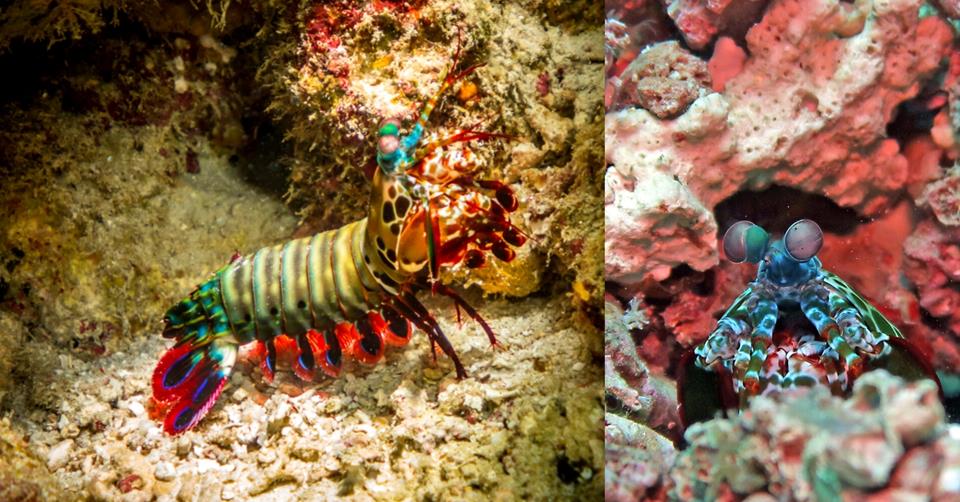
Mantis shrimps’ eyes are unique in the animal kingdom. Trinocular vision means that, for depth perception, 3 points are used for the calculation. Each eye can triangulate depth individually.
The eyes are on stocks and move independently. Humans only have binocular vision, using 1 point of reference on each eye to judge depth.
Mantis shrimp also have 12-16 types of photoreceptors to detect different colors. Humans only have 3. So the mantis shrimp’s eye is capable of seeing the world uniquely. Strangely, though, because they are quick to strike predators, these colors are not processed by the brain much.
Most of their visual input skips processing, allowing for the reactionary striking of prey without thinking. This is similar to how humans process pain. If you touch something burning hot, your hand automatically moves away before your brain actually processes what has happened.
Mantis shrimp do not mix colors as the human brain does, so instead of seeing a full spectrum of colors, they only see certain specific narrow wavelengths. They would see the world similar to if a box of crayons drew it. Humans mix colors like you would see in a water color painting.
Mantis shrimp also have a high dynamic range. If the sun is shining directly on a reef, but some crevices are covered in shadow, they can simultaneously see in the brightness and the darkness. Humans must wait for their eyes to adjust to seeing in the dark or the light. They cannot see both at the same time.
5. Monogamy
Some Mantis species are monogamous, staying hidden in their burrow together for their entire lives to avoid predators. This means a mantis shrimp couple could stay together for their entire 20-year life span if they find a good home.
But most mantis shrimp are not monogamous. They live strictly solitary lives, only interacting with others during mating season. Mating is quick, happens once per year, and the female either carries the eggs or cares for them in her burrow.
4. Audio and visual communications
On the California coast, males were observed making a low-frequency rumbling pitch around dusk and dawn. Mantis shrimp create this noise by vibrating their muscles. Mantis Shrimp do not have ears, but they can detect this rumbling with small sensory hairs on their bodies. Scientists believe males produce this sound for territorial purposes and to attract females to their locations.
I will not go into the physics of this, but Mantis shrimp are one of the only animals that can see circularly polarized light. This allows them to filter out glare and background noise to detect prey easier.
They also can control how they reflect circularly polarized light off their bodies. They use this invisible light to communicate secretly with each other. The mantis shrimp’s legs, head and tail are used to express body language. These areas of the shrimp are covered in a color pattern that reflects circularly polarized light, so they can secretly communicate their body language long distance.
Mantis Shrimp was requested by my scuba subscriber, Nick. You can request in the comments too, and I always need more ideas for new animal science tv episodes.
3. Biomimicry research
The unique way mantis shrimp see the world is used for cancer detection. Doctors use cameras that detect light like the mantis shrimp does because cancer cells reflect circularly polarized light differently than healthy cells.
Scientists are also studying how the smashing mantis shrimp doesn’t break its own clubs after repeated strikes. It turns out that behind their clubs, they have a unique Elastic polysaccharide chitin arranged in a shock-absorbent manner.
It prevents small cracks from becoming full cracks. Engineers are considering using this design in military body armor, vehicle frames, and aircraft plating.
CHECK-OUT: Biomimicry 101: Innovation inspired by nature
2. Habitat and range
Mantis shrimp are ubiquitous, but not much is known about them. They are primarily found in the shallow tropical waters of the Pacific and Indian oceans. They usually make burrows in coral reefs and hunt using their amazing eyes at night.
That being said, mantis shrimp are very diverse, and some are diurnal. They have been found in every ocean and even the Mediterranean sea. They have been spotted at depths of 4,000 feet; some can even thrive in arctic waters.
1. Predators and threats
Mantis shrimp are heavily armored, good hiders, and speedy swimmers. They move at 30 body lengths per second, meaning larger species can move in 20mph bursts of speed. 20mph is quite impressive when water resistance is taken into account.
Sometimes they are preyed upon by large fish, rays, sharks, orcas, or other animals that could eat them in one bite while they are out in the ocean. Their overall elusiveness, combined with their deadly counterattacks, make them closer to apex predators than a prey item.
Humans eat mantis shrimp as a delicacy and for their sweaty meat, but they are pretty hard to swallow and catch. They are not threatened directly by humans, but in the end, climate change may be their demise. Like all crustaceans, they face a long-term extinction threat caused by ocean acidification and coral bleaching.
The next cool animal to be featured will be the pig. It was used in war by Alexander the great because of its super annoying squeal!
Please watch more cool animal facts in this playlist up here. I also do 101 science education videos
Head to my Youtube playlist where you can choose between animal facts, animal education , and animal news.
SAVE THIS ARTICLE ON YOUR PINTEREST BY PINNING THE IMAGE BELOW
