Chameleons are mostly native to Madagascar, and their tongues whip out at 100 km/h! Did you know chameleons don’t actually change colors for camouflage? Today, we learn 10 cool facts about Chameleons.
Below is an 8-minute video for you to watch. But if you prefer to read, keep scrolling:
RELATED VIDEO AND POST: Cool facts about water striders and Gross facts about cockroaches
10 COOL FACTS ABOUT CHAMELEONS
Chameleons are cute and colourful animals, with lots of incredible abilities. Let’s learn about what makes them so cool and fun:
10. Weaponized tongues
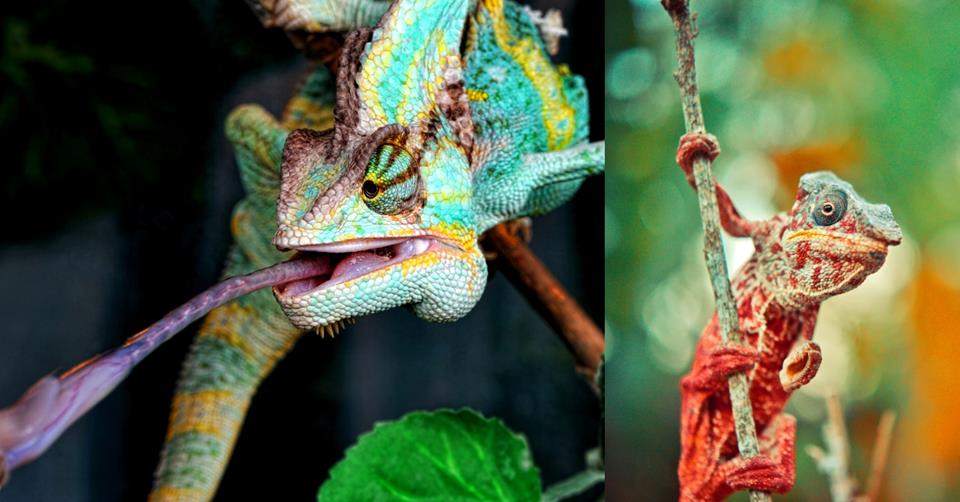
The chameleon has the longest tongue to body-size ratio of all animals. It has unique acceleration and retraction muscles, and the tip is covered in a sticky pad.
The tongue is blasted out like a whip at 100KMH. It can even stretch to up to 2x the length of the chameleon’s body as it snatches a meal.
9. Independently moving eyes
The chameleon can focus on 2 different things at once. The eyes have a huge range of rotation, offering 360-degree vision.
Chameleons’ primary survival tactic is to stay hidden, and most of the time, they are looking in different directions to scan for predators. Snakes and birds of prey like to eat chameleons, which are much slower than other lizards.
When hunting, the chameleon uses its eyes like humans and other predators do. Focusing 2 eyes on 1 target allows animals to judge distance accurately. This is called binocular vision. Chameleons have great vision and can spot insects from over 10 meters away.
Their eyelids are also unique. The thick top and bottom lids are fused, and only a hole the size of the pupil remains. Imagine looking through 2 toilet paper rolls. The sun can only damage this animal’s eyes if it looks directly at the sun.
8. Prehensile tails
Chameleons have beautiful tails. Like many arboreol species, they can wrap it around branches to hang on safely. Arboreol species spend most of their lives in the trees. To communicate aggression towards other chameleons, the tail will coil up tightly.
7. Why do chameleons change colors?
Contrary to popular belief, Chameleons actually do not change colors to blend in with the surroundings. Think about it, how would looking like this help you hide?!
The fact is, that chameleons are cold-blooded and change colors to regulate temperature. In the desert, the chameleons will turn close to white when they are too hot and black if they are cold. Black absorbs more heat than lighter colors do.
Chameleons also change colors based on their moods or when stressed. If you have a pet chameleon, let me know in the comments what color it turns when it’s unhappy.
They also change colors for mating purposes. Females choose which male they want to mate with, and to impress the female, the male will do a mating dance and display its beautiful colors. If she doesn’t like the way he looks, she will turn black to communicate her disapproval.
6. Chromatophores
Chromatophores explain how chameleons change color. These are specialized cells that can control the distribution of the pigments inside.
When the pigments are all compacted together in the center, the cell is mostly transparent, with a black dot in the middle. When chameleons die, they turn black because the chromatophores are no longer functioning.
This ability to change colors is called “Metachrosis”. Cephalopods like the octopus and squid can use their chromatophores to actually blend in with their environment.
5. No eardrums
Chameleons have a lot of structures on their head, but none of them are actually an outer-ear. They even lack the middle ear including ear drums. Chameleons can, however, hear a small range of sounds from 200-600 hertz, but they just mostly sense vibrations.
Chameleons showed up about 65 million years ago, and I don’t know why they didn’t evolve better hearing. Their other senses must simply be good enough for them to survive.
4. Nearly Invisible Teeth
Chameleons do have teeth, but they are so small that we usually can’t even see them!
These teeth are specialized to crunch and chew up big insects like grasshoppers, but they can also eat smaller lizards and baby birds.
If the wallopping impact of the tongue doesn’t kill an insect, the chameleon’s jaw is strong enough to finish it off. Most chameleons can draw blood if they bite humans.
But before the chameleon bites, it will puff up and hiss as a warning sign, much like a snake.
3. Zygodactyl feet
Zygodactyl feet have some toes pointing forward and others pointing backwards. It looks like their feet are little pincers, with the toes at almost 180-degree angles.
They actually do have 5 toes, 2 toes on one side, and 3 on the other. This makes it harder to run fast, but very easy to grab onto things.
2. Blowing in the wind
If a chameleon thinks it has been spotted or is trying to hide, you will see some strange movement. They bounce back and forth to look like leaves blowing in the wind. If you see a chameleon doing this, it means it wants to be invisible.
1. Great Diversity
There are 171 species of Chameleons that have been discovered so far. They live in all sorts of different environments, from the jungle to the desert. About half of the Chameleon species on Earth call Madagascar their home.
Brookesia micra is the smallest species, growing only up to 3cm long. I would love to have these cute pygmy chameleons as a pet!
FINAL THOUGHTS
Chameleons are undeniably captivating creatures, embodying nature’s artistry and innovation.
With their exceptional color-changing abilities, swiveling eyes that grant almost 360-degree vision, and lightning-fast tongues, they are a testament to evolution’s ingenuity.
These characteristics, coupled with their unique locomotion and varying sizes, make chameleons not just a wonder of the animal kingdom but also an inspiration for technology and design.
I hope you found this list of cool facts about chameleons informative and entertaining.
ARE YOU ON PINTEREST? SAVE THIS FOR LATER READ