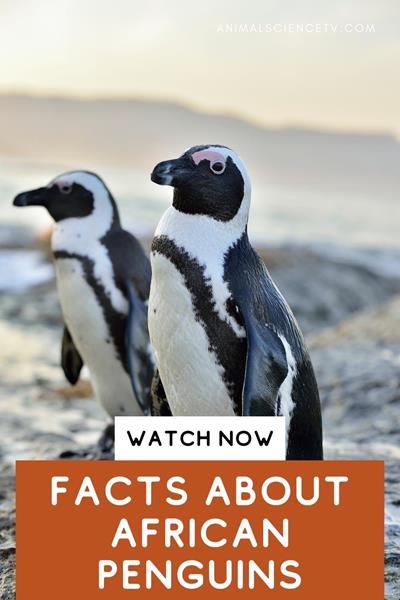
Do you know that you can find penguins on the continent of Africa? They are different from the penguins in Antarctica.
In this video, I talked about the 10 cool facts about African Penguins and why they are awesome creatures. If you prefer to read, scroll down the video below.
10 COOL FACTS ABOUT AFRICAN PENGUIN
The African Penguin, a unique species adorned with bold, black and white feathers and a distinct braying call, is an emblem of southern Africa’s coastal regions. Inhabiting the shores and islands of South Africa and Namibia, these penguins are the only penguin species breeding on the African continent.
I’ve seen African penguins in person when I visit Boulder’s Beach colony in South Africa, near Cape Town. They are protected animals in this region, and humans are not allowed to get near them for everyone’s safety.
RELATED VIDEO/POST: 10 cool facts about giraffes and 10 cool facts about African grey parrots
10. Classified as a fish in 1488
The Portuguese colonists who settled near Cape Town, South Africa, were fundamental Catholics. Their religion didn’t allow them to eat meat on Fridays, but they were allowed to eat fish. This strange new bird swam a lot, so they simply defined it as a fish. This was a loophole that let them eat meat on Fridays. Fish that tastes like chicken. Nice!
9. Annual molting
Every year, the African Penguin sheds its feathers and grows a new coat. Most birds shed only a few feathers at a time as a continuous process that does not interrupt their mobility. Unfortunately, the African penguin loses all of its feathers at the same time. The penguin’s feathers are waterproof and help it survive in the cold water.
8. Amazing dieters
The molting process takes about 3 weeks, and the penguins cannot swim while molting. This is very bad news because they eat only fish. This means an African Penguin loses half of its body weight while it starves for 3 weeks. You can notice how irritable the molting penguins are.
7. Mates for life
Penguins are monogamous and usually find their breeding partner at the age of 4. The breeding pair will generally stay together for the rest of their lives, which is about 15 years.
They produce 2 eggs per year, and both parents take turns incubating and looking after the nest. But, if one mate is lost or late to return to the colony for breeding season, the other mate will find a new partner.

6. African Penguins have a lot of predators
Penguins have evolved to be excellent swimmers, so they are not very capable of defending themselves on land. Eggs and newborns are at risk of predators like snakes, mongooses, and gulls.
Penguins are much more agile in the water, but they still need to watch out for sharks and cape fur seals, which are big enough to eat an adult.
5. Slow swimmers
They only swim 8km/h on average. Michael Phelps can swim faster, at about 9.5km/h. The African Penguin can double its speed on the surface. They do a maneuver called “porpoising.”
This involves jumping in and out of the water quickly while breathing fast. Jumping into the air with short bursts of speed helps reduce the drag of water resistance. Also, the penguin can do a burst of speed up to 19kmh while chasing prey.
4. Excellent breath holders
The African Penguin can hold its breath for almost 3 minutes while swimming. They have been seen at depths of 100 meters. Swimming slowly helps them save energy and oxygen. Imagine how long you could hold your breath while walking vs. sprinting.
3. The Jackass Penguin
This species of penguin was originally dubbed “The Jackass Penguin” because of the sound it makes. Unlike songbirds, they sound like donkeys. They are only found in South Africa and Namibia, so the name “African Penguin” or “Cape Penguin” is more fitting than calling it a jackass.
Cape penguins can swim an impressive 70km out to sea, but that is not far enough to reach a new continent, so Africa will always be their home.
2. An endangered species
The population has declined from about 2,000,000 to 50,0000 since the Industrial Revolution. That means that when compared to 1760, the population is only 2.5% today.
This catastrophic decline was caused by the usual suspects: Overfishing of their food supply, which includes small fish like anchovies, and habitat destruction caused by coastal development.
Also, before they were recognized as an endangered species, humans ate their eggs and scraped the guano off of the rocks they called home. Guano was used as a fertilizer.
1. Conservation Efforts
Happily, there are strong conservation efforts happening today, and the population appears to be stable.
Boulders Penguin Colony and Stony Point Nature Reserve are tourist destinations near Capetown, where you can observe these penguins for yourself in their natural environment. That is where I took these videos.
How long can you hold your breath while sprinting?
ARE YOU ON PINTEREST? SAVE THIS TO READ LATER: