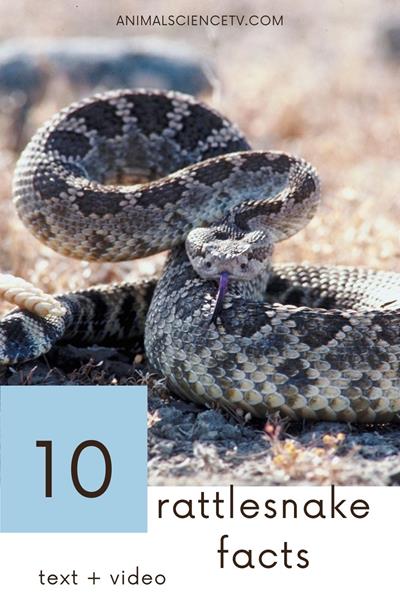
The rattlesnake possesses organs that can sense beyond what humans and other animals can. The Jacobson’s organ and split tongue allow them to smell in 2D, and the pit organ creates a 3d heatmap of their surroundings even in the dark.
All of these rattlesnake facts will teach us what makes these venomous animals such special predators. The rattlesnake’s rattle itself is a unique predator deterrent system in the animal kingdom. Here are the 10 rattlesnake facts video:
10 RATTLESNAKE FACTS
If you don’t like watching videos, below is a text version of 10 interesting pieces of information about rattlesnakes that might even save your life.
ALSO, READ OR WATCH: 10 Cool Facts About Seahorses
10. 3D heat sensors
Rattlesnakes belong to a subfamily called “pit vipers.” I used to think this means they live in a pit, a pit you really really wouldn’t want to fall into – but no.
Pit vipers are unique because they have organs called “pits” that look almost like a 2nd set of nostrils. These pits detect infrared light and can sense heat from a candle 30 ft away.
Rattlesnakes process this heat information in the same section of the brain used to process visual information, so they create something like a 3d heat map of their surroundings.
These organs are used mainly to detect hidden, warm-blooded prey, like mice.
9. Fangs
Rattlesnakes are venomous ambush predators. so They coil up and hide, waiting for an unlucky rodent, bird, insect, or reptile to move within striking range.
They only eat once every 2 weeks, so they have plenty of time to wait for the right opportunity.
When this snake strikes, it opens its mouth almost 180 degrees and unfolds its 2 hollow top fangs. These modified teeth can be up to 2 inches long, and the only way to fit the fangs in the mouth is for them to be attached to a rotatable part of their skull, called the maxilla.
Humans have a maxillary bone but it is fused to the skull.
When the bite occurs, the snake latches on with its much smaller recurved teeth and at the same time, jams its fangs deep inside of its victim.
A lethal dose of paralyzing Venom is quickly injected under pressure, like a doctor using a syringe.
Rather than hanging on, the rattlesnakes let the prey attempt to run away until the venom takes effect.
There’s No need to damage a fang while the prey thrashes around in agony but even a broken fang can quickly be regrown.
8. Forked tongues
A Rattlesnake can easily follow a dying meal’s scent trail by using its tongue. It’s split into 2 tips and grabs airborne odor chemicals from different locations at the same time.
Snakes don’t actually smell with their tongues. They need to retract their tongues first to gain information.
Once retracted, a separate organ on the roof of the mouth, called the “Jabobson’s organ,” does the actual sensing of the odors on the 2 tongue tips.
The Jacobson’s organ can process odor gradients and allows the rattlesnake to determine which direction a smell is coming from.
When the rattlesnake follows the scent trail and finally catches up to its dead or completely immobilized meal, it proceeds to eat it whole, without chewing.
7. Natural predators and defences
Rattlesnakes themselves are sometimes eaten by large birds of prey, foxes, feral cats, and the king snake. The Kingsnake is a non-poisonous constrictor type immune to the rattlesnake venom!
Because rattlesnakes are not apex predators like the giant anaconda or the Burmese python, they can switch off hunting mode and turn on prey-animal mode.
When threatened, a rattlesnake will quietly try to slither away or hide using its camouflage, but if cornered, it starts showing defensive behavior.
They use common snake techniques like regurgitating a meal to escape faster, coiling up, puffing, hissing, and delivering defensive bites.
When rattlesnakes strike defensively though, they tend to conserve venom. They rely more upon the instant impact of pain to startle predators away.
Rattle Snakes try to send the message: “I see you. I am big, noisy, and aggressive. Go find something less dangerous to eat.”
But we forgot their coolest predator deterrent system!
6. Rattles
Rattlesnakes vibrate their tails to make a startling buzzing sound. Every time a rattlesnake sheds its skin, it adds another segment to the rattle.
The rattle consists of dried scale rings stacked at the tip of the tail. It is brittle and can break off, so sometimes a rattlesnake might not actually even have a rattle!
This noise-maker is not used to communicate with other rattlesnakes. The reason we know this is that snakes can’t hear it. They lack an eardrum to detect airborne sounds.
This complex rattle evolved from snakes who simply shook their tails silently certainly a much less startling defence.
5. Venom cocktails
Speaking of evolution, rattlesnakes are one of the newest snakes to emerge on earth. The 1st rattlesnake showed up only about 14 million years ago, and according to genetic analysis, it possessed a cocktail of 3 venom types.
This common ancestor killed its prey with a combination of (1) Hemotoxin, which destroys red blood cells and causes internal bleeding.
(2) Neurotoxin, which interferes with cell signaling, and causes paralysis or disrupts breathing and heart rate.
and (3) myotoxin, which destroys muscles, causing cramping, and necrosis.
Myotoxins can stop animals from running away, or even better, stop their diaphram muscle from working!
By using 3 venoms at the same time, the 1st rattlesnake was a great general predator.
Rattlesnakes quickly spread across north, south, and central America, diverging into several different species. Species specialized to thrive in the unique environments that they found themselves in.
These environments had different prey animals that were weaker to certain toxins and stronger against others.
For example, hemotoxins work better in warm weather and aid in digesting larger slow prey, while neurotoxins act faster and can paralyze a small quick rabbit almost instantly.
Today, rattlesnakes mostly are masters of just 1 of the 3 venom types.
4. umping genes
Rattlesnakes can adapt their venom type much faster than evolution normally would allow for within just a few generations.
Their Venom proteins are mostly coded for on something called “jumping genes.” These transposable segments of DNA can move around in the genome, allowing their expression to be switched on or off.
Normally, to remove a trait, evolution would work through gradual genetic mutation, resulting in permanent deletion.
But, rattlesnakes can save the genetic code needed to produce various venom. It can instantly turn back on in 1 generation, instead of having to evolve a second time.
The venom production genes jump back and forth from the on and off positions between generations. There is no gradual change over time here!
3. New World snakes
Rattlesnakes are native to the Americas, which is often referred to in biology as the new world.
Today, there are 36 species of rattlesnakes, a number that keeps changing.
They are most common in the deserts of North America. but, you can find them almost everywhere. From the Florida everglades to 11,000-foot-tall mountains. and The prairie rattlesnake even lives as far north as Canada!
All species of rattlesnakes give live births, which is quite rare among reptiles.
Females incubate about 10 eggs internally, and upon birth, the babies all go their own different ways. She doesn’t provide for them at all. Bad mom!
However, Rattlesnake dens are often multigenerational, and can be hundreds of years old! So Mom might see her offspring again in the den when winter rolls around.
A big thanks to my new Patreon, Bianco Artistica. The support really really helps keep me motivated as I launch this Animal Science TV project.
2. Cold-blooded brumation
Being cold-blooded, rattlesnakes cannot control their body temperatures with metabolism. They rely on heat from the sun, air, and ground to keep them at their ideal operating temperature of 70-90F.
95 degrees is fatal for rattlesnakes, so On hot summer days, rattlesnakes hunt during the night. Their slitted eyes can open into wide, round pupils for better night vision than other snakes have.
And vice versa, a 40-degree body temperature is too cold for rattlesnakes. This means rattlesnakes have to retreat to underground dens below the frost line to avoid literally freezing to death.
You probably already know about hibernation, where some mammals sleep all winter long at a constantly reduced body temperature.
Snakes do something similar called but it is called “Brumation.” During brumation, metabolism is reduced by 70%, but the cold-blooded rattlesnake is at the mercy of environmental temperatures.
Brumation is different from hibernation because snakes can wake up on short notice if there is a hot day.
You might spot a rattlesnake outside in the middle of winter soaking up the sun or trying to grab a quick snack. Brumation works based on temperature, while hibernation is more based on a seasonal internal clock.
1. The danger to humans
Rattlesnakes CAN and DO kill humans with their potent venom, but most of the time they simply choose not to inject a lethal dose. When interacting with humans, rattlesnakes are in prey mode, not predator mode.
Young rattlesnakes have smaller venom glands, but can actually be more dangerous than adults because they haven’t yet learned how to control venom release.
57% of bites occur to people who are intentionally handling rattlesnakes, and another 28% of attacks happen to intoxicated people.
Antidotes are very effective if you can get one within 30 minutes, otherwise, a fully loaded venomous bite could cause death within 6-48 hours.
Rattlesnake toxins cause organ damage and might take years off of the end of your life even if you do naturally recover, so be careful, these animals are not toys!
Rattlesnakes are important in balancing the ecosystem because they act as both a predator and prey animal.
Practically, they keep agricultural pest populations in check and reduce disease in humans. For example, the timber rattlesnake eats mice that carry Lyme disease bacteria that could be transferred to humans by ticks.
Rattlesnakes are highly specialized hunters, but they don’t perceive humans as food! Scaring the crap out of us is their way of keeping themselves safe!
Head to my Youtube playlist where you can choose between animal facts, animal education , and animal news.
ARE YOU ON PINTEREST? SAVE THIS FOR LATER READ