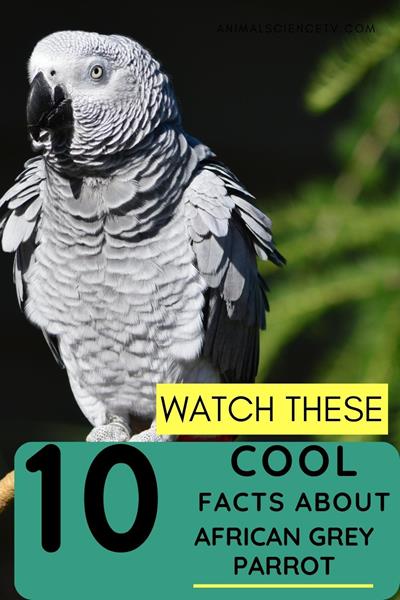
These African Grey Parrots are the best at mimicking human speech. They can sometimes communicate with the police, but how do they survive in the wild? The African Grey Parrot can talk and has an 80-year lifespan. What makes them such popular exotic pets?
Today, let’s learn about cool facts about African Grey Parrots and how to save them from illegal poaching. If you prefer to watch it in a video, it’s available on my Youtube channel.
COOL FACTS ABOUT AFRICAN GREY PARROT
These birds are one of the most intelligent animals ever studied and are unmatched in their ability to mimic human speech. Today, we learn how they survive in the wild, and what makes them such popular exotic pets.
1. Chatterboxes
In captivity, African Grey Parrots are often heard repeating the sounds of loud objects around them. They can mimic a ring tone, microwave beep, or toilet flush.
Some African greys can also sing short snippets such as the theme song from your favorite TV show.
But most impressive is the African Grey Parrot’s ability to copy the human voice.
They can even associate contextual meaning with the words that they learn. They can follow vocal commands and express emotions.
For example, when Alex the parrot was taken somewhere uncomfortable, he was able to say “Want to go back?”
In nature, parrots use this audio mimicry to establish their own local dialect. By listening, a parrot can tell if the other parrot belongs in their territory or not.
Their social intelligence allows them to communicate detailed information, such as location, presence of a predator, food discovery, distress, or safety status.
In the wild, African grey parrots are playful and very loud. They often entertain themselves by chatting with friends or sharing any cool new sounds they heard during the day.
2. Brainy birds
The African Grey Parrot has the mental and emotional intelligence of a 4 to 6 years old human. They can even mix and match words.
Alex the parrot was taught the 2 words: banana and cracker. But what will he say when presented with a dried banana chip? Well, He drew from his vocabulary, and invented a new word: “banana cracker!”
In the lab, African Grey Parrots demonstrated they can understand concepts like:
- Bigger or smaller?
- Same or different?
- Basic math
- Sharing
3. Mystery solvers
To further prove that African Grey Parrots are smart, here are 2 incredible examples of them using their unique skills to pass along very important information.
Japan
In Japan, a lost African Grey Parrot was rescued on an urban rooftop by police. It had no identification, so the police started investigating who the owner could be. But they didn’t have to look long, because the parrot told them the answer.
In Japanese, it said, “I am Mr Yosuke Nakamura.” And after a few days, Yosuke Nakamura also said his home address. Police looked up the address, and indeed the home registered there was to the Nakamura family.
USA
In the USA, Bud’s owner was found shot dead on the floor. The parrot kept repeating a heated argument that ends with the words “Don’t fucking shoot!”
The African Gray was mimicking the owner’s voice when he repeated “don’t fucking shoot!” making it obvious that this was not a self-inflicted gunshot.
Prosecutors considered using the parrot as an eye witness in court, but it wasn’t necessary.
I feel bad for bud, he is depressed and constantly replaying the murder of his favorite human over and over in his head and aloud.
4. An Exotic habitat and appearance
African Grey Parrots are native to equatorial Africa and are spread across 23 countries. They prefer living in dense rainforests. near rivers and lakes. But sometimes are found in the savannah and have been spotted in 2,200 ft highlands.
There are actually 2 different species, a fact which went unrecognized by ornithologists until 2012. The most notable differences are that the Timneh Grey parrot lives further west than the Congo Grey parrot. The Timneh is slightly smaller with a less colorful tail.
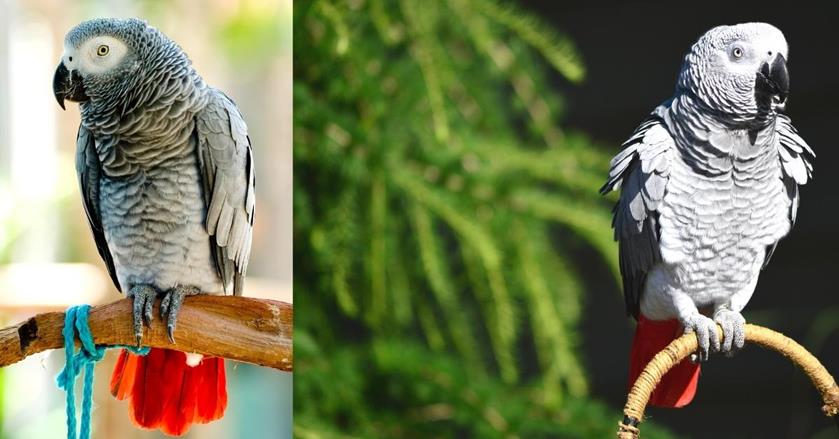
Both species feature many shades of grey, yellow eyes, and signature red tails. Males and females look quite similar. They certainly do not display the extreme sexual dimorphism we see in birds like the peacock and mallard duck.
Adults are 1 foot tall, but only weigh a single pound because they have hollow bones.
5. Safety in numbers
Hatchlings and eggs can’t fly, so they make easy meals for animals like monkeys, pythons, jaguars, and large birds of prey.
Adults can swarm and fight off predators with their sharp beaks and talons, but their number one defense is to fly away.
African Grey Parrots are subject to ambush predators while scavenging on the ground.
As a prey animal, if an individual parrot is surrounded by 1000s of friends, it has only a tiny chance of being singled out by a stalking cat. Alone, the cat would have no other targets but that individual.
That is why African Grey Parrots live in large, noisy, social colonies called flocks, which contain hundreds or thousands of individuals.
In a flock, parrots can use their excellent communication skills to look out for one another. In nature, parrots are quite jumpy, and a single warning call could scatter thousands.
Flock members also take turns feeding. Half will eat, while the other half stands guard, waiting for its turn. These flocks are further broken down into smaller units called broods. Broods are multigenerational, and the chicks raised together tend to stay in the same brood.
A brood has 30-50 members collaborating, socializing, and roosting in the treetops together every night.
Roosting in large numbers helps keep the parrots safe from predators at night. Birds can sleep with one eye open, allowing them to rest one half of their brain at a time. These are probably my favorite cool facts about African Grey Parrots.
CHECK OUT: Facts about cats
6. Fruit lovers
The African Grey Parrot’s favorite food in the wild is oil palm fruit. These oil palms are like normal palm trees, but they don’t grow coconuts. African Greys also love tree bark and kola nuts.
It’s dangerous, but sometimes African Greys scavenge food off of the ground. Nuts, seeds, and rare insects or snails are on the menu for protein.
In captivity, they can survive on bird feed, but African Grey Parrots will be much happier with apples, bananas, cucumbers, peas, and green beans.
7. High-up homes and good dads
Not only do African Grey Parrots like to eat oil palms, but they also nest in them during breeding season as well. They will only nest in trees over 30 feet tall and only in ones with good hiding spaces.
A hole in a trunk is the best, and a breeding pair may even steal the home of smaller birds like the woodpecker.
African Grey Parrots are very picky and require a tree all to themselves when it is baby-making time. The female lays 2-5 eggs in the nook and incubates them for 1 month. She does not leave the nest for this time and relies on the male to bring her food.
New hatchlings spend the next 3 months in the nest growing feathers and learning to fly. During their development, mom and dad both take turns feeding, protecting and teaching survival skills.
The chicks eventually leave the nest but usually join the family brood and begin building social connections. After 3 years, the babies form monogamous breeding pairs and the cycle repeats.
In African Grey Parrots, the male is notably much more helpful in raising the babies than in other species of birds where the males sleep around.
8. Not a beginner’s pet
African Grey Parrots are popular because of their social behavior and the entertainment value provided by their mimicry. But, with a 50-80 year life span, they likely will outlive you.
In nature, parrots lead complex lives within the flock. Their social, play, and exercise needs will take quite a bit of work to be met in captivity.
9. International trade ban
According to researchers, Ghana has lost 90 to 99% of its African Grey Parrots since just 1992. Across Africa, about 21% of the population is trapped every year. In Congo, locals will cut down trees to grab hatchlings and will catch adults with a glue-covered pole.
More than half of the captured parrots die on their way to market. So, it isn’t suprising that in 2016 Grey Parrot exports were banned internationally, and in 2018 the animal was listed as endangered.
But rules are made to be broken, and at a price of $1000+ per bird, the trade will not be stopped entirely. Poaching is pretty detrimental, but the worst problem is probably deforestation.
The logging industry prefers to cut tall trees, so African Grey Parrots are having a harder time finding suitable trees to reproduce in.
But not all is doom and gloom!
World Parrot Trust
A quick thanks to “The World Parrot Trust” for providing us with some great photos. Check out “parrots.org” if you want to get involved or donate to help their conservation effort.
10. Not the way of the Dodo
African Grey Parrots have a few advantages over other endangered animals. First, they can fly. So populations are not isolated by structures like roads and fences.
The famous expression, “to go the way of the dodo” refers to a bird that went extinct in the 1600s. Dodos only lived on 1 island and were flightless.
Second, they live in 23 different countries. Some countries are already enforcing trapping regulations and launching conservation efforts. The wild African Grey Parrots will eventually find safe havens in some of these 23 countries.
Third, with international trade banned, more and more breeders are popping up. If local breeders can satisfy the exotic pet demand, poaching will be less profitable and the wild African Grey Parrots will be safer. However, if people can realize that these animals are suitable pets, no demand means no poaching – that would be the best solution.
FINAL WORD
The African Grey Parrot is such a wonderful animal. Its intelligence, social skills, voice mimicry, and beauty all make it too popular for its own good.
I hope that you found this list of cool facts about African Grey Parrots enjoyable and helpful. Subscribe to my channel to watch and learn more about animals. I also have a playlist to help you find which type of animal videos you want to binge-watch.
SAVE THIS ARTICLE ON YOUR PINTEREST BY PINNING THE IMAGE BELOW