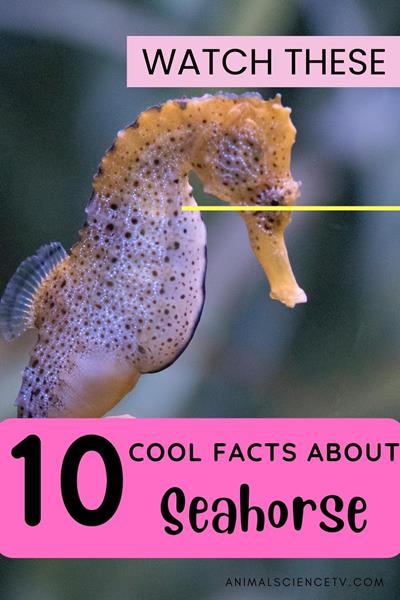
Today we learn 10 Cool Facts about Seahorses. How fast do seahorses swim? Does the male seahorse truly get pregnant and give birth? These seahorse facts shocked me! What do you think of these videos showing seahorse birth, seahorse camouflage, and seahorse swimming?
Seahorses are way cooler than I thought! They are vertically swimming fish and the slowest swimming fish on earth. They have true male pregnancy! Check out Animal Science TV on YouTube for more Animal videos.
10 Cool Seahorse Facts
What advantages does looking like this have? Today we learn what makes the seahorse such a unique and successful animal.
My name is Chris, and welcome to Animal Science TV.
ALSO READ OR WATCH: 10 facts about Jackrabbits and 5 Gross facts about raccoon roundworm
10. A strange anatomy
Believe it or not, the sea horse isn’t actually a horse.
When first discovered, they were thought to be insects and in greek mythology, seahorses pulled the God Posideon around in an underwater chariot.
Today, scientists know the sea horse is one of the few fish that swims vertically. It is covered in spiky, boney plates.
These plates form a protective exoskeleton, and the sea horse has evolved to lose its ribs, which had become no longer necessary to protect its organs.
Seahorses vary in size based on species. At just one inch long we have the pygmy sea horse. The big-bellied seahorse is the largest, 14 inches long.
9. Male pregnancy
Seahorses are one of the only animals which have true male pregnancies.
Females lay eggs in the male’s “brood pouch.” The male then fertilizes and nurtures the eggs for the next month or so.
The male provides nutrients, oxygen, waste removal, immune defence, and protection from the outside world.
When gestation is complete, the male releases between 5-1500 live-born juveniles, called “fry”.
The bigger the species, the more babies. Contractions can last around 12 hours. Once born, they drift away from dad in the currents. Only about 1% of fry survive until adulthood.
8. Life partners
Many seahorses form monogamous reproductive pairs that last a lifetime.
Females have a large territory, about the size of a basketball court. Males have a much smaller territory, about the size of a telephone booth!
The males’ territory is inside the females’ territory, and she comes over to see him when she wants to. They spend about 2 hours courting each other every day.
This includes swimming around with linked tails, changing colors, and singing which sounds more like lip-smacking.
7. Terrible swimmers
The pygmy seahorse is the slowest fish in the world. It can only swim about 5ft per hour.
Seahorses have a big dorsal fin on their back, that propels them forward. It beats about 35 times per second so fast you cannot really see it moving, like a hummingbird’s wings.
They also have fins on the sides of their heads, under the gills, that are used for steering.
To move up and down, they have a swim bladder. The swim bladder can change the amount of air inside of it, allowing the animal to maintain neutral bouncy at variable depths.
6. Big schnozes
Another unique feature of seahorses is their straw-like snouts. The mouth fits into small crevices and can stretch to fit bigger meals inside.
It can draw a vacuum from over an inch away, which sucks live prey inside the mouth. But seahorses have no teeth.
Since the seahorse cannot chew, it dissolves prey whole in the mouth and then passes it through the intestines. Seahorses don’t have a stomach.
5. A carnivorous diet
Seahorses are predators. They feed on things like fish larvae, brine shrimp, and plankton.
Because seahorses cannot fully digest their food, they have to eat more than 50 times per day. Without a stomach, Food passes through their system quite quickly, so they have to eat almost constantly.
4. Natural predators
Not many feeds on seahorses, because they are boney and spiky. They also are incredibly hard to see. Some animals that eat seahorses include penguins, sea turtles, crabs, sharks, and some larger fish that can crush their exoskeleton or eat them whole.
A BIG thanks to my Patreons for supporting the Animal Science TV project. You can help too, if you want to, for just 1 dollar a month!
3. Active camoflauge
Can you see the seahorse in this photo? They can change colors to mimic the environment they find themselves in. Here it is!
The Seahorse uses its prehensile tail to grab onto things like seaweed, corals, and grass. They sway back in forth in the currents with whatever they are attached to, and spend minimal time in open waters where they could be spotted.
Changing colors keep them safe, but also helps them hunt as ambush predators. They hunt by sight and also have independently moving eyes.
This lets them see potential prey without having to move their bodies. Staying stationary while seeing in all directions makes them very hard to detect.
Leave me a comment! Have you ever seen an animal with adaptive camoflauge in the wild? I have been snorkeling and diving many times, but have never seen a seahorse maybe it was there though!
2. Habitat and population decline
Seahorses can be found worldwide in ocean waters, or in brackish estuaries where a river mixes with salt water. They are more common in warm waters but can be found in the colder waters of New Zealand and Eastern Canada.
They live in extremely shallow waters, and in environments with a really poor visible range.
You can find seahorses in mangrove forests, seagrass beds, mud flats, and on shallow coral reefs.
They thrive in these tidal waters because they can hold themselves in place as currents change. The seahorse’s prehensile tail is vital to its success.
Unfortunately, these coastal waters make the seahorse vulnerable to urban development, toxic run-off and being accidentally caught in fishing nets.
The population of seahorses is largely unknown, but 12 of the 47 species around the world are listed as vulnerable, which is 1 step away from endangered. Populations are estimated to be only about 50% of what they were 20 years ago.
Because the seahorse is such a bad swimmer, it is not able to migrate when conditions get bad. This makes the seahorse more vulnerable to habitat loss and climate change than most fish.
1. Bad pets and TCM
Seahorses are notoriously one of the hardest and most expensive fish to keep in an aquarium. They are extremely sensitive to water chemistry and are not beginner fish.
Less than 1% of pet seahorses survive more than 6 weeks. In nature, smaller species live 1 year, and larger species over 5 years.
Also, more than 150 million seahorses are harvested for use in the Traditional Chinese medicine industry.
TCM thinks seahorses can be used to cure infertility, baldness, asthma, and arthritis.
There is no real science behind these claims, and I have a disdain for these myths.
They lead to the poaching of 36 types of exotic animals, including tigers, rhinos, black bears, and of course the sea horse!
NEXT TO WATCH OR READ…
Next on animal science TV, we cover the Grey Parrot! These intelligent birds can mimic human speech, and some can even understand what they are saying!
Head to my Youtube playlist where you can choose between animal facts, animal education , and animal news.
Thanks for watching animal science TV!
SAVE THE PHOTO BELOW ON YOUR PINTEREST TO BOOKMARK: